
ECO4 Scheme
Energy Company Obligation Phase 4
Free Boiler & Insulation Upgrade ?
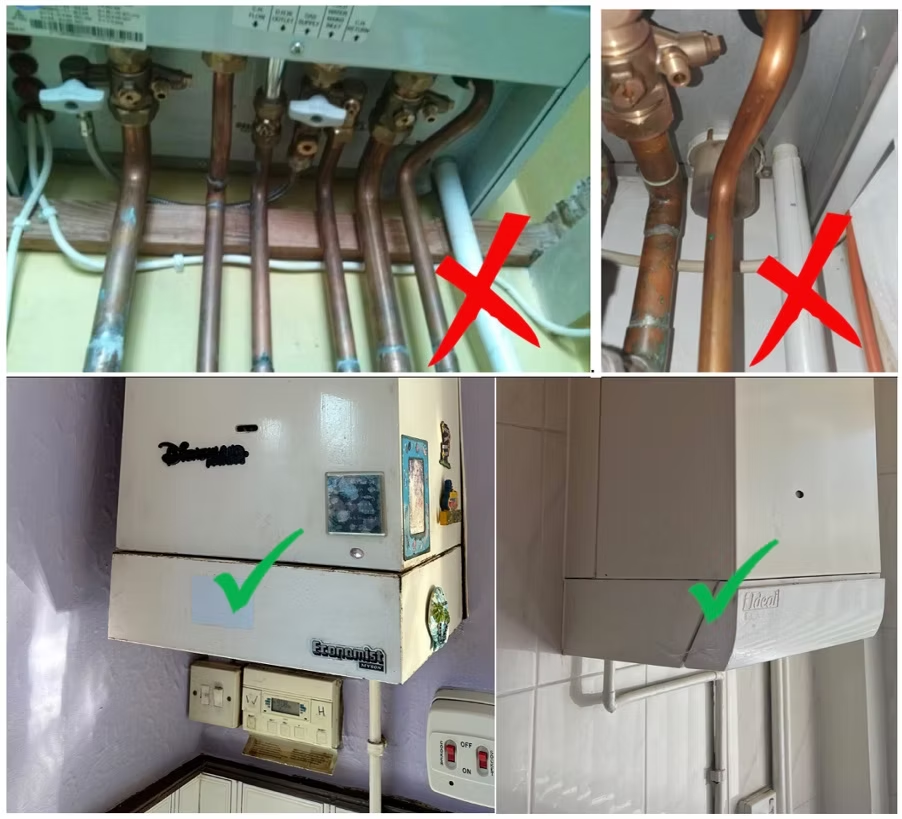
If you have an old boiler (the source of 60% of your energy bills) or poor loft insulation, you could be eligible for a 100% free grant under the ECO4 scheme. New, efficient systems are cheaper to run, cut CO2 emissions, and save you money.
What Is ECO4?
The ECO4 Scheme (Energy Company Obligation Phase 4) is a UK Government–backed energy efficiency initiative regulated by Ofgem.
It requires large energy suppliers to fund home energy-saving improvements helping households make their homes warmer, greener, and more affordable to heat.
ECO4 is part of the UK’s commitment to reduce carbon emissions and reach Net Zero by 2050.
What Does ECO4 Offer?
The scheme can fund or part-fund a variety of energy-saving upgrades, depending on your property and eligibility route:
🏠 Heating Upgrades
Replacing old or broken boilers with modern A-rated condensing models
Air-source heat pumps (where suitable)
Smart heating controls and thermostats
🧱 Insulation Improvements
Loft, cavity-wall, internal or external wall insulation
Underfloor and room-in-roof insulation
☀️ Renewable Measures (where applicable)
Some properties may be eligible for solar PV or renewable heating support, depending on assessment results and supplier participation
All installations must meet PAS 2035 quality standards and are carried out by certified installers.
Who can apply?
Why is it %100 free (Insulation & Boiler)
Under the Government's newly launched ECO4 Scheme, there is a huge push on helping lower energy bills accross the UK, where there is £1 Billion worth of funding per year.
Don't just take our word for it
Do a google search for "ECO4 Delivery guidance v1.1" where you can review a PDF on OFGEM (Office of Gas and Electricity Markets) website. Check out pages 57-58, 106 & 124. Click Here.
Three Qualifying Routes:
- Qualifying Benefits (Route 1): Where someone in the household is in receipt of means tested benefits, such as Pension Credit, Tax Credits, Universal Credits etc...
- Low Income (Route 2): Where household earns less than £31,000 ( before tax)
-
NHS Referral Health Conditions (Route 3):
If a member of your household suffers from a severe or long-term health condition that is worsened by living in a cold home, you may be eligible for an ECO4 (LA Flex) grant via an NHS referral (Route 3).
This route allows you to qualify without needing to meet low-income or benefits criteria.
Our healthcare professional (e.g., GP or NHS Trust) will certify that the patient's condition falls into one of these four categories:
1. Cardiovascular Condition: Illnesses of the heart and blood vessels, such as: Heart Disease, Hypertension (High Blood Pressure), or those recovering from a Stroke.
2. Respiratory Disease: Conditions affecting the lungs, often worsened by damp/cold, such as: Asthma, COPD (Chronic Obstructive Pulmonary Disease), or Chronic Bronchitis.
3. Limited Mobility: Conditions that significantly restrict movement and make it difficult to keep warm, such as: Severe Arthritis, Parkinson's Disease, or Neurological disorders.
4. Immunosuppression: A weakened immune system due to conditions or treatments, such as: Active Cancer treatment (chemotherapy/radiotherapy), HIV/AIDS, or Autoimmune diseases.


Resources on ECO4 grant on offecial websites


Benefits of ECO4
✓ Lower Annual energy bills
✓ A warmer, more comfortable home
✓ Improved EPC rating and property valye
✓ Reduced carbon emissions
✓ Access to fully regulated, government-approved funding
✓ Free insulation & boiler if eligible
Compliance & Transparency
UK Saves Energy is not part of the UK Government or Ofgem. We are an independent awareness service, helping households understand official schemes and connect with approved, certified installers. All scheme details are based on public information from GOV.UK and Ofgem.

Want to know details of ECO4?
Summary
The Energy Company Obligation (ECO) is a UK government-mandated energy efficiency scheme obliging larger energy suppliers to deliver improvements to domestic properties, with the aim of reducing fuel bills and carbon emissions. The current phase is ECO4 (commencing April 2022 / formally from 27 July 2022) and will run until 31 March 2026 and the focus is mainly on making upgrades throughout the whole house, prioritizing the least energy efficient homes. To the end of March 2025, around 4.2 million measures have been installed in approximately 2.5 million properties under the overall ECO scheme, specifically under ECO4 there have been roughly 810,700 measures installed across about 243,900 households, the estimated annual bill savings from ECO4 measures to that date total approximately £138.5 million HHCRO (Home Heating Cost Reduction Obligation) component.What is the ECO4 scheme
The Energy Company Obligation (ECO) is a government-mandated energy efficiency scheme that requires large energy suppliers to fund and deliver improvements to domestic homes.Its focus is:
– Reduce carbon emissions from the housing stock.
– Cut household energy bills, specifically for low-income and vulnerable households.
– Support the UK’s net-zero and fuel poverty targets.
ECO isn’t a government-budgeted grant, it’s an obligation on private energy companies, who then pass on the cost through energy tariffs. Ofgem (Office of Gas and Electricity Markets) regulates and audits this process.
Who is involved
UK Government: Sets the overall policy and legal framework through ECO Orders.Ofgem (Office of Gas and Electricity Markets): Regulates suppliers, enforces compliance, and publishes data.
Energy Suppliers: Companies like British Gas, Octopus, E.ON, and EDF must meet targets for bill savings by funding or installing approved measures.
Installers and Contractors: Carry out insulation, heating, and retrofit works in homes.
Local Authorities: Identify eligible households under “ECO Flex” and coordinate delivery locally.
When did it start and What stage are we in now
– ECO1 (2013–2015): initial scheme replacing CERT and CESP.– ECO2 (2015–2017): refined targeting and reduced costs.
– ECO3 (2018–2022): focus on low-income households (Home Heating Cost Reduction Obligation – HHCRO).
– ECO4 (2022–2026): the current phase — launched officially on 27 July 2022, running until 31 March 2026.
Each phase adjusts funding rules, eligible measures, and targets.
Where does it apply
ECO applies across Great Britain — that’s England, Scotland, and Wales (Northern Ireland has a separate energy efficiency policy).Regional delivery data shows concentration in:
• Northwest England (around 18–19 % of measures),
•West Midlands and Yorkshire & Humber, with somewhat lower delivery rates in the Southeast and rural Scotland.
Why does the UK have ECO funds
The scheme exists to tackle three interlinked national issues:1.High household energy bills — particularly affecting low-income families.
2.Poor energy efficiency — the UK has some of the oldest, least efficient housing stock in Europe.
3.Carbon emissions — domestic energy use contributes significantly to the UK’s overall emissions; upgrading homes supports the Net Zero 2050 goal. ⁷
In short: ECO funds are a policy instrument to make homes warmer, cheaper to heat, and less polluting.
How much funding and impact are we talking about
– Total cost of ECO4 to date (as of spring 2025): roughly £3.6 billion, plus around £90 million in administrative costs.–Approx. 810,000 measures have been installed in 243,000 households, delivering about £138.5 million in annual bill savings so far.
–Average cost-effectiveness ratio: £22.36 spent per £1 annual bill saving — which is acceptable in policy terms but not exceptional.
–Average measures per home: about 4 – 5 (showing that the “whole-house” model is being applied).
How Does the Scheme Work
• Large energy suppliers must meet legally binding energy efficiency targets set by the government.•They achieve these by funding improvements (like insulation or heating upgrades) in qualifying homes.
•Each improvement earns a “score” based on its potential to reduce energy bills and emissions.
•Ofgem monitors progress and ensures compliance.
•The costs are covered indirectly through customer energy bills, rather than through direct government spending.
What are the current challenges
1.being applied Installation quality: A 2025 audit found that up to 98 % of external wall insulation installations may require corrective work — a serious consumer-protection concern.
2.Cost vs benefit: High unit costs risk reducing overall reach if not managed carefully.
3.Targeting: A large share of benefits go to owner-occupiers rather than private renters or off-grid homes, limiting reach to the most vulnerable. ¹⁰
4.Regional imbalance: Delivery uneven across regions, depending on local authority engagement and installer capacity.
5.Complex delivery chain: Multi-measure projects can be delayed or poorly coordinated without strong oversight.
The Energy Company Obligation (ECO) is one of the UK’s most significant energy efficiency schemes. It has evolved since 2013 to better support low-income households and reduce emissions. While not perfect, ¹² ECO remains a cornerstone of the UK’s approach to tackling fuel poverty and meeting its environmental goals.